Demographics
 Lite
Lite
Lite
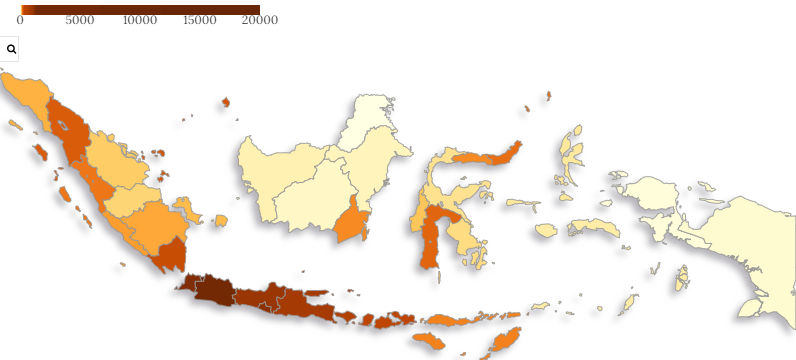
Indonesia's Six Most Populous Javanese Provinces

Viva Budy Kusnandar
14/09/2021 09:15
WIB

Memuat...
Six provinces in Java have the highest population density compared to other regions in Indonesia. This is evident from the darker color of the six Javanese provinces on the graph.
- A Font Kecil
- A Font Sedang
- A Font Besar

Access single data
Indonesia's Six Most Populous Javanese Provinces
Want to get more access to Data Stories with a more affordable price? Subscribe.
By subscribing, you join us in presenting quality data.
Get:
- Premium Data Stories access
- Comfortable reading without ads
- Download data in XLS, PDF, and image format
- Access to data source information
Basic
Rp100.000
Rp50.000/month
Professional
Rp100.000
Rp150.000/month
Institutional
For organizations
We accept the following payments:



Related Data


Latest Data Stories

Monthly Per Capita Expenditure in Central Papua 2025
Consumer Services & Health
08/08/2026, 15:42
WIB


Alert! Mount Ibu Erupted Again This Afternoon (Saturday, 8 August 2026)
Demographics
08/08/2026, 15:05
WIB


Mount Lewotobi Laki-laki Erupted Again This Afternoon (Saturday, 8 August 2026)
Demographics
08/08/2026, 14:32
WIB

Market Data
Macro update by
08 August 2026
| Name | Value | % | |
|---|---|---|---|
| Inflasi yoy (Jul) | 2,88% | -0.46 | |
| Inflasi mom (Jul) | -0,14% | -0.58 | |
| Economic growth | 5,11% | +0.08 | |
| Pertumbuhan ekonomi (yoy) (Q1) | 5,61% | +4.08 | |
| Persentase kemiskinan (Mar) | 8,07% | -0.18 | |
| Gini rasio (Sem2) | 0,38 | 0.00 | |
| Nilai Tukar USDIDR | 17.916 | +0.01 | |
| PDB ADHK (Q1) | 3.447,70 | -0.77 | |
| Neraca perdagangan (Jun) | -450,50 | -72.02 | |
| Ekspor Migas (Jun) | 1,07 | +40.52 | |
| Impor Migas (Jun) | 4,56 | +0.96 | |
| Ekspor (Jun) | 25,46 | +9.72 | |
| Impor (Jun) | 25,91 | +4.41 | |
| Kunjungan Wisman (Mei) | 1,38 | +10.69 | |
| NTP (Jul) | 116,16 | +1.32 |
Trending Topics
Popular Data